
One inference engine for on-device AI across smartphones, laptops, and edge hardware. Run LLMs, transcription, and embeddings locally with automatic cloud fallback.
About
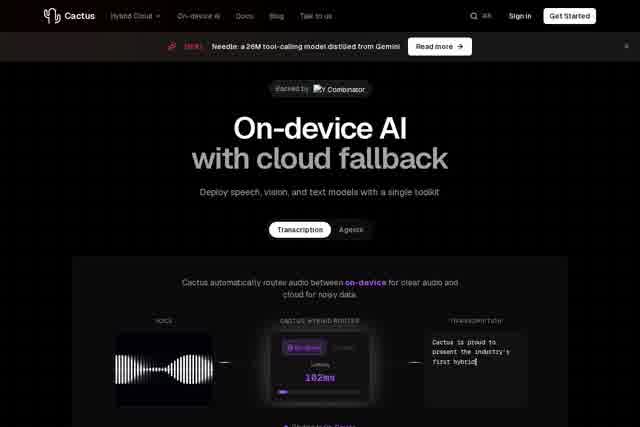
Cactus is a local AI engine built for smartphones, laptops, and edge hardware. It provides a unified inference runtime that lets developers run large language models (LLMs), speech transcription, and text embeddings directly on end-user devices. The core strength of Cactus lies in moving AI processing from the cloud to the local device, ensuring data privacy while delivering millisecond-level response times. When on-device compute is insufficient, it automatically falls back to the cloud, guaranteeing uninterrupted service.
Key Features
Pricing & Fees
- Pricing: Not publicly listed on the pages we reviewed; check the official site for current plans.
- Hosted fine-tuning plans: The site exposes a plans endpoint for hosted fine-tuning and references Starter (one-time purchase) and Pro (subscription) tiers, with API keys managed in the billing dashboard.
- Free local usage: The base Needle 3 model is openly downloadable and can be run and evaluated locally at no cost; Whistle speech recognition and Needle 3 are open models.
- Model footprint: Needle 3 ships as a single 8–29 MB binary with sub-2-bit quantization; the smallest models run CPU-only on budget phones, wearables and Raspberry Pis, with no GPU or server required.
Who It's For
Cactus is designed for mobile app developers looking to integrate intelligent chat, real-time translation, or voice assistant features into their apps; edge computing engineers who need to run AI inference on low-power devices such as IoT gateways and industrial PCs; enterprise IT teams pursuing on-premise data processing while retaining the ability to scale elastically through the cloud; indie developers and startups that want to quickly validate AI product prototypes without incurring high initial cloud service costs; and academic researchers who need to test and fine-tune models on local hardware without depending on lab server clusters.
Related Tutorials
View all →

Related Tools
View all → 9Router - Free AI Router Free AI routing with smart 3-tier fallback. Maximize subscriptions, auto-switch to cheap/free models. Never stop coding with Claude Code, Codex, Gemini CLI.
 OpenRouter OpenRouter is a unified, OpenAI-compatible API that gives developers pay-as-you-go access to 500+ AI models for text, image, video, and audio from 80+ providers.
 LangChain LangChain provides a comprehensive suite of products to support developers throughout their entire development workflow.
 Claude Claude is an AI assistant made by Anthropic that answers questions, writes and edits text, analyzes documents, and helps with coding through natural conversation.
 Coplay - AI Assistant for Unity Game Development Elevate your Unity game development with Coplay, a fully collaborative AI partner designed to amplify developer impact. Install today and supercharge your workflow.