
The open-source AI enterprise search platform that helps teams find information across all company data.
About
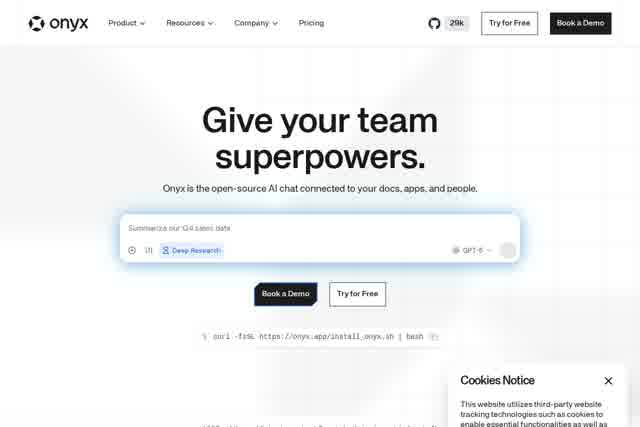
Onyx AI is an open-source intelligent enterprise search and AI assistant platform built for modern teams, helping users quickly and accurately find information scattered across various company systems. Whether it’s documents, knowledge bases, chat histories, or data from project management tools, Onyx AI leverages powerful semantic understanding and retrieval capabilities to consolidate fragmented information into a searchable, conversational knowledge network. As a fully open-source product, Onyx AI gives enterprises complete control over their data and algorithms while lowering the barrier to deployment and usage, making intelligent search no longer exclusive to large corporations.
Key Features
Pricing & Fees
- Pricing: Two plans are listed on the official pricing page. Business costs $20 per user per month with annual billing, while Enterprise uses flexible, contact-sales pricing with volume discounts and higher-education pricing available.
- Free Tier & Trial: A free trial is offered for the Business plan ("Start Free Trial"), plus a "Try for Free" option and demo booking; no permanent free tier is described on the pricing page.
- Business Plan Features: Includes chat and search UI, access to major LLMs, custom AI agents, actions (MCP/OpenAPI), 40+ app connectors, web search, deep research, code interpreter, image generation, Slack integration, developer APIs, RBAC, and community support.
- Enterprise Additions: Adds OIDC/SAML SSO, on-premise and region-specific deployments, white-labelling, custom integrations, data exports, invoice billing, and a dedicated support SLA.
- Open Source & Self-Hosting: Onyx's core platform is open source (GitHub) with Docker-based deployment, so organizations can self-host independently; the product is SOC 2 Type II certified and GDPR compliant.
Who It's For
Onyx AI is suitable for enterprises and organizations of all sizes, particularly: technical teams looking to build internal knowledge retrieval systems while reducing reliance on third-party services and safeguarding data sovereignty; knowledge-intensive departments such as R&D, product, legal, and consulting that frequently need to reference large volumes of internal documents and historical records; remote or hybrid teams whose members are distributed across different locations and need a unified information hub to eliminate data silos; and data-sensitive organizations in finance, healthcare, and government sectors that require private deployment due to strict data security and compliance regulations.
Related Tutorials
View all →

Related Tools
View all → Dograh - Voice Workflow Dograh is an open-source voice assistant workflow building platform that lets you visually orchestrate voice agent flows.
 Cici AI Cici AI is an AI assistant that offers smart solutions. It helps users with daily tasks and questions.
 Noty.ai - Meeting AI Assistant Noty.ai is an AI meeting assistant that captures, transcribes, and provides insights from your meetings.
 Frigate NVR An AI-powered NVR with real-time object detection for smarter security.
 Mistral AI - Open AI Alternative Mistral AI provides enterprises with customizable AI platforms for deploying assistants, agents, and multimodal AI using open models.