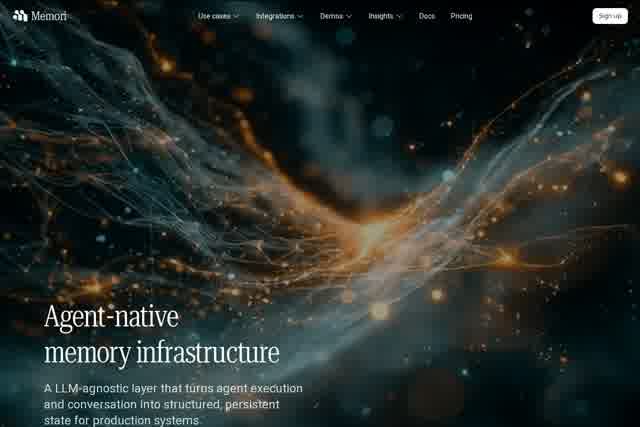
Memori – Agent-native memory infrastructure

Memori – Agent-native memory infrastructure

4.0

Memori is native memory infrastructure for AI Agents, providing long-term memory storage and retrieval.

Last Updated Nov 25, 2026
Memori – Agent-native memory infrastructure screenshot

About

Memori is a memory infrastructure designed specifically for AI-native applications, aiming to provide intelligent agents with persistent, structured, and retrievable long-term memory capabilities. In traditional AI conversations and applications, models often lack effective memory of past interactions, resulting in fragmented user experiences and poor task continuity. By building a unified memory layer, Memori enables AI agents to "remember" the past, understand context, and continuously learn and grow across multiple interactions—just like humans. Whether it's a personal assistant, customer service bot, or complex workflow automation system, Memori can infuse it with a true "memory soul."

Key Features

Long-term Memory Storage: Supports persistent storage of conversation history, user preferences, key decision points, and other data, freeing you from context window limitations.
Intelligent Retrieval & Recall: Quickly locates the most relevant memory fragments from massive amounts of data using semantic similarity and time-decay algorithms.
Structured Memory Management: Supports categorization, tagging, priority ranking, and automatic archiving of memories, enabling agents to organize knowledge efficiently.
Multi-agent Memory Sharing: Allows different agent instances to access the same memory pool, ensuring information synchronization and consistency in collaborative scenarios.
Real-time Updates & Forgetting Mechanism: Supports dynamic writing of new memories, with built-in privacy-compliant automatic forgetting policies to ensure data compliance.

Who It's For

  • AI Application Developers: Need to add persistent memory capabilities to products like chatbots and virtual assistants to boost user engagement.
  • Automation Workflow Engineers: Building multi-step, cross-session workflow agents that ensure task states are never lost.
  • Enterprise AI Platform Teams: Setting up a unified memory service layer to support the memory needs of multiple internal AI applications.
  • Researchers and Experimenters: Exploring how memory mechanisms affect agent behavior and long-term learning outcomes.

FAQ

What is the difference between Memori and a vector database?Memori not only provides vector storage and retrieval, but also has built-in memory management logic (such as priority, recency, and relevance). It is a complete infrastructure optimized specifically for agent scenarios.

What resources are required to deploy Memori?A minimal deployment only requires a server or local environment that supports Docker. For production environments, at least 4GB of RAM and SSD storage are recommended.

Is it possible to customize memory expiration times?Yes. You can set independent TTLs (time-to-live) for different categories of memories, and the system will automatically clean up expired data.

How is the security of memory data ensured?Memori provides transport layer encryption (TLS), encryption at rest, and role-based access control (RBAC), and supports user-level data isolation.

More

Key Advantages

  • Pricing: Memori offers a free open-source self-hosted version, a $0 Cloud Free tier (5,000 memory creations / 15,000 recalls), Team plans starting at $60K/year, Business plans starting at $150K/year, and a custom-quoted Enterprise plan.
  • Free tier: Cloud Free is a fully managed cloud version, ideal for exploration and lightweight workflows; the open-source self-hosted option supports bring-your-own-database (BYODB) with full access to the SDK and MCP server.
  • Plan limits: Cloud Free is capped at 5,000 memory creations and 15,000 memory recalls; all paid production plans offer unlimited memory creation and recalls.
  • Deployment by plan: Team is a managed multi-tenant cloud supporting a single production-grade agent; Business is a Memori-managed single-tenant cloud supporting multiple agents; Enterprise supports customer VPC or on-premises deployment with dedicated infrastructure.
  • Enterprise add-ons: Enterprise additionally provides advanced evaluations with retention attribution, custom SLAs, forward-deployed engineering support, and optional outcome-based pricing.