
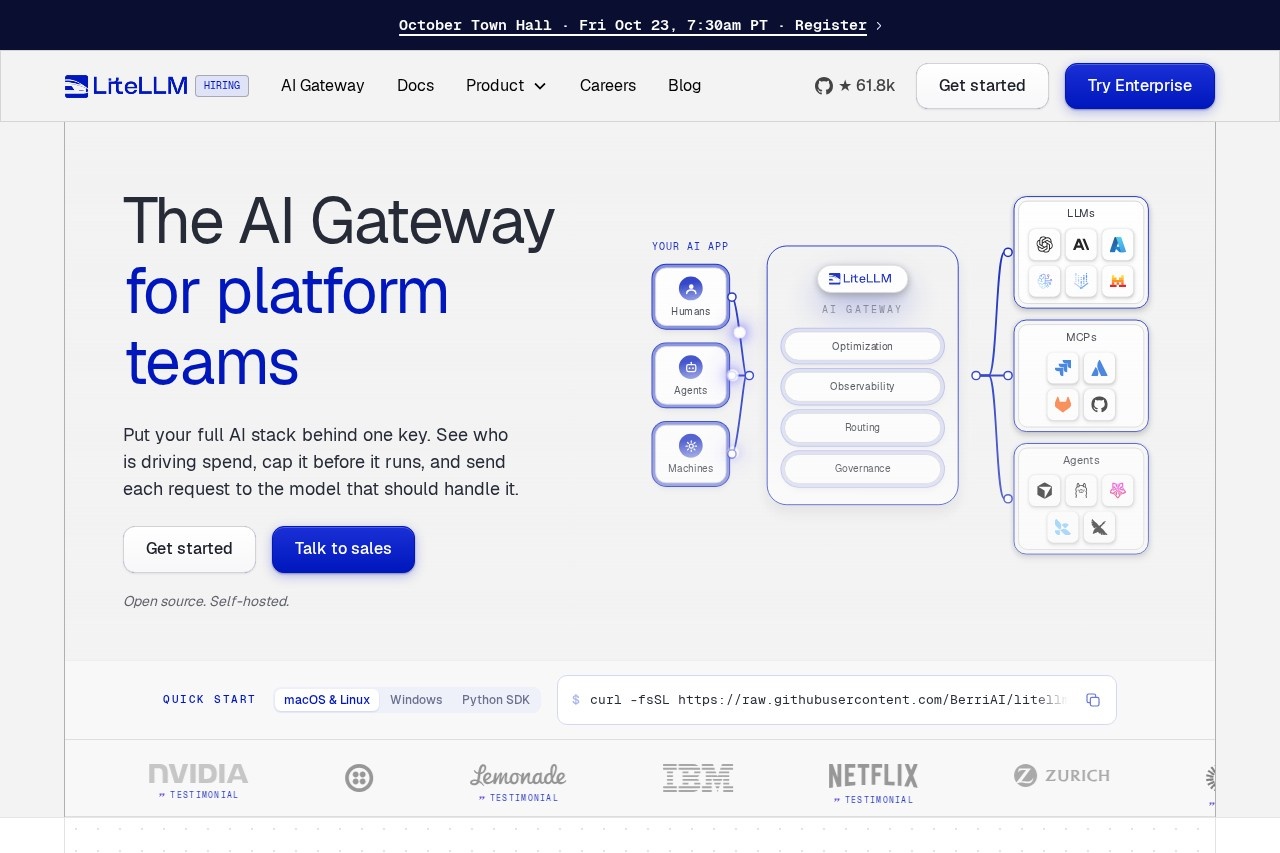
LiteLLM is an open-source AI gateway and Python SDK that puts 100+ LLM providers, MCP servers, and agents behind one OpenAI-compatible API, with budgets, routing, and spend tracking for platform teams.
About
LiteLLM is an open-source AI gateway and Python SDK, developed by Berri AI, that solves a common problem for teams building with large language models: managing many providers, keys, budgets, and routing rules across separate APIs. It places 100+ LLM providers, MCP servers, and agents behind a single OpenAI-compatible API, so an application can switch models without code changes.
The gateway is self-hosted, meaning prompts, responses, and provider keys stay on the user's own infrastructure. Teams issue virtual keys scoped by project or team, set per-key and per-team budgets, and track spend as requests happen. The core project is MIT licensed, with additional features available under a commercial enterprise license. A Python SDK is also available for applications that need direct provider calls without running a server.
Key Features
Pricing & Fees
- Pricing: Not publicly listed on the pages we reviewed; check the official site for current plans. The core is open source under the MIT license, and enterprise features are sold separately.
- Quick deployment: A one-command quickstart script (Docker, Podman, or Rancher Desktop with Compose v2) brings up the gateway, Postgres, and admin UI.
- Day-zero model support: New models are added as they ship, and internal fine-tuned or self-hosted models can sit behind the same key.
- Noted users: Testimonials on the site include engineers from NVIDIA, Netflix, Okta, Lemonade, and AT&T, which reported cutting some AI coding costs by 56%.
Who It's For
LiteLLM is built primarily for platform and infrastructure teams that need to give an entire organization access to multiple AI providers without becoming a bottleneck. It suits backend developers who want one SDK across providers, engineering leads who need per-team budgets and spend accountability, and enterprises that must keep keys and request logs inside their own infrastructure for security review. Typical use cases include multi-provider applications, cost-capped customer-facing features, failover during provider outages, and routing coding agents such as Claude Code or Codex through a controlled internal endpoint.
FAQ
What is LiteLLM?LiteLLM is an open-source AI gateway and Python SDK from Berri AI that exposes 100+ LLM providers, agents, and MCP servers through one OpenAI-compatible API, with keys, budgets, routing, and guardrails.
Is LiteLLM free?The core gateway and SDK are open source under the MIT license; enterprise features require a commercial license, and plan prices are not publicly listed on the pages reviewed.
Which providers and platforms does LiteLLM support?It supports 140+ providers including OpenAI, Anthropic, Google Vertex AI, AWS Bedrock, and self-hosted models, reachable from any language through its OpenAI-compatible REST API.
How is LiteLLM deployed?It is self-hosted, typically via a Docker-based quickstart that runs the gateway, a Postgres database, and an admin UI, so all keys and request data stay on the operator's own infrastructure.
Does LiteLLM help control AI costs?Yes: virtual keys and teams can carry per-key and per-team budgets, requests are tracked in real time, and routing rules can send work to cheaper models, which AT&T credited with up to 56% lower costs for some coding tasks.
Related Tutorials
View all →

Related Tools
View all → OpenRouter OpenRouter is a unified, OpenAI-compatible API that gives developers pay-as-you-go access to 500+ AI models for text, image, video, and audio from 80+ providers.
 LangChain LangChain provides a comprehensive suite of products to support developers throughout their entire development workflow.
 OrcaRouter OrcaRouter is an OpenAI-compatible AI gateway that adaptively routes prompts across 200+ models with failover, guardrails and zero token markup for developers and teams.
 Tokenhot Tokenhot is a unified LLM API gateway that puts 100+ text, image, video and TTS models from 30+ providers behind one OpenAI-compatible endpoint with pay-as-you-go billing.
 ZenMux ZenMux is an enterprise LLM gateway that unifies access to 100+ AI models through one API, with intelligent routing and automatic compensation for subpar outputs.