
Open-source, self-hosted AI agent with persistent memory, autonomous scheduling, and multi-surface access on your hardware.
About
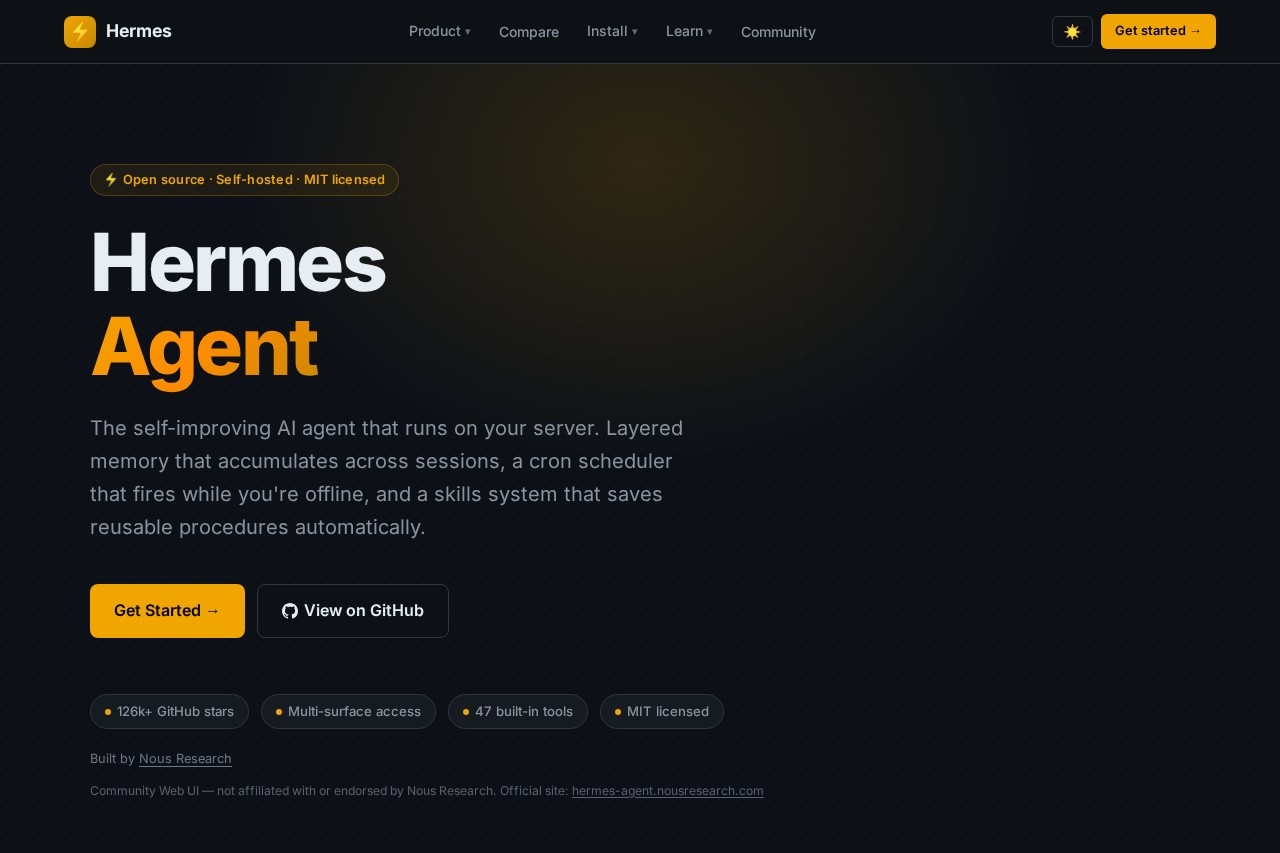
Hermes — Community Web UI is an open-source, self-hosted graphical interface built for AI agents. It breaks away from traditional AI tools that depend on cloud services, allowing you to deploy an intelligent agent with persistent memory, autonomous scheduling, and multi-surface interaction entirely on hardware you control. Whether you are an individual developer, a small team, or an organization with strict data privacy requirements, Hermes provides a free, secure, and powerful AI operations platform.
Key Features
Pricing & Fees
- Pricing: Not publicly listed on the pages we reviewed; check the official site for current plans.
- Open source and MIT licensed: The full codebase is publicly available under an MIT license, so the software itself is free to use, audit, and modify.
- Self-hosted: Hermes runs as a persistent process on your own server, with memory stored as markdown files in ~/.hermes/, so there are no subscription fees beyond your own hardware and any model API costs.
- Low hardware requirements: The lightweight architecture runs on modest hardware such as a Raspberry Pi or an older PC.
- Community support: An active community provides plugins, templates, and troubleshooting help; the Web UI project is not affiliated with or endorsed by Nous Research.
Who It's For
Hermes is designed for privacy-conscious users who want a fully local AI experience without routing personal data through third-party servers. It also suits developers and tinkerers who need a customizable, programmable AI framework for building automation workflows or experimental projects. Small teams and startups on a tight budget can use it to deploy a dedicated AI assistant that boosts internal collaboration, while educators and researchers benefit from a transparent, reproducible AI system for teaching demos and academic experiments.
Related Tutorials
View all →

Related Tools
View all → OmniRoute - Free AI Gateway for Multi-Provider LLMs Free, open-source AI router with auto-fallback. 236 providers, one endpoint, 95 MCP tools, 17 routing strategies, A2A protocol, auto-combo engine, semantic cache, memory & skills. Deploy anywhere.
 Dograh - Voice Workflow Dograh is an open-source voice assistant workflow building platform that lets you visually orchestrate voice agent flows.
 OpenHands Open-source, model-agnostic platform for building and deploying cloud coding agents. Automate real engineering work securely with full transparency and control.
 Agent-Native Apps Framework Build agentic apps where AI agents and UI share the same database and state. Open source framework with ready-to-fork templates.
 DeepSeek TUI - Terminal Coding Agent Terminal-native coding agent built on DeepSeek V4. Open source. Community site for installation, docs, roadmap, and live activity from the Hmbown/deepseek-tui repo.